The corner and the song
Esquina Homero Manzi and Sur
Who Homero Manzi was, how the tango Sur put the corner of San Juan and Boedo on the map, and what the café has been called since the 1920s.
Reserve the Boedo tango show ↗Quick answer
Esquina Homero Manzi is the café at the corner of Avenida San Juan and Avenida Boedo in Buenos Aires, named after the tango lyricist Homero Manzi (1907 to 1951). He wrote the words of Sur, with music by Aníbal Troilo, in 1948, and Buenos Aires city tourism says he wrote it at one of the café’s tables. The corner is a National Historic Site, and today the café stages tango dinner shows.
Who Homero Manzi was
Homero Manzi was born Homero Nicolás Manzione Prestera on 1 November 1907 in Añatuya, in the province of Santiago del Estero. Wikipedia calls him a tango lyricist and also a filmmaker. He worked briefly in journalism, then taught literature and Spanish until political reasons tied to his membership of the Unión Cívica Radical got him expelled from teaching, and turned to the arts. He died in Buenos Aires on 3 May 1951, of cancer, at the age of 43. In 1935 he had taken part in the early days of FORJA, a political group that Wikipedia describes as people’s nationalism.
Songs and screenplays
Manzi worked in two media. In 1934 he founded a magazine called Micrófono, covering radio and Argentine cinema, and he co-wrote the screenplay of Nobleza Gaucha, released in 1937. From 1940 he wrote screenplays with Ulyses Petit de Murat, and Wikipedia says the pair won the Silver Condor for best adapted screenplay in 1943 for The Gaucho War. In tango he is best known for words set to music by Aníbal Troilo and Lucio Demare: Sur, Barrio de tango, Malena and Che bandoneón. Wikipedia also lists films such as The Caranchos of Florida (1938) and Savage Pampas (1945) among his credits, without specifying his role in each.
A poet of the south side
Spanish Wikipedia says Manzi spent his youth in Pompeya, a neighbourhood in the south of the city, and that it inspired many of his tangos; a street there now bears his name. The venue’s own site puts it simply: a single work like Sur is enough to describe Manzi as a man of Buenos Aires. That sense of a poet tied to his streets is the idea this café is built around.
The song Sur
Sur has music by Aníbal Troilo and words by Manzi. Wikipedia says Troilo’s orchestra first recorded it on 23 February 1948, with Edmundo Rivero singing, and that it came out that year on RCA Victor. The same artists first performed it live at a night club in Buenos Aires called Tibidabo. The singer made two small changes to the words with Manzi’s approval; one replaced ‘florando’ with ‘flotando’, and that became the widely accepted version. Covers include recordings by Julio Sosa, Nelly Omar, Roberto Goyeneche and Andrés Calamaro. Wikipedia adds that Troilo and Manzi had other hits in the 1940s, but none matched Sur, which it calls perhaps the tango most loved by Argentines.
Aníbal Troilo, the other half of Sur
Aníbal Troilo was born in Buenos Aires on 11 July 1914 and died on 18 May 1975. Known as Pichuco, a name his father gave him, he was a bandoneón player, composer, arranger and bandleader, and Wikipedia says his orchestra was among the most popular with social dancers during tango’s golden age. Manzi wrote the words for Troilo’s music in Sur, Barrio de tango and Che bandoneón, and after Manzi died in 1951 Troilo wrote Responso in his memory. Edmundo Rivero, who sang Sur in 1948, recorded with Troilo again later, including the 1963 album Tango recio.
What the song is about
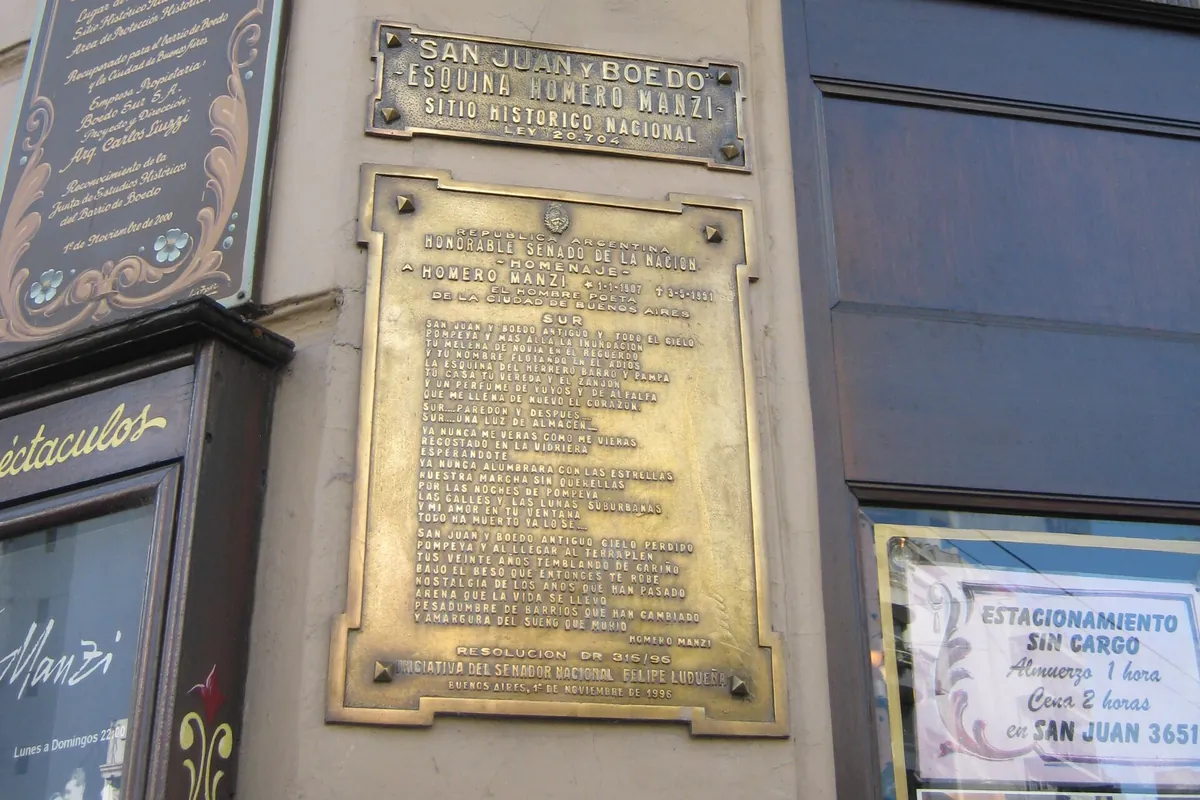
Wikipedia describes Sur as an elegy for a lost love, set among landmarks of Buenos Aires’s south side, and as a lament for how the neighbourhood has changed. The corner of San Juan and Boedo is one of the places the song names, and Buenos Aires city tourism says the corner was immortalised by the poet in it. This guide does not quote the words; a brass plaque on the café’s own wall carries them, and any recording lets you hear them sung.
Hearing it before you go
Any streaming service has the 1948 recording by Troilo’s orchestra with Edmundo Rivero, and the later covers make a good comparison: Julio Sosa, Roberto Goyeneche and Andrés Calamaro each sing it differently. Then try Malena, which Wikipedia dates to 1941 with music by Lucio Demare, and Che bandoneón from 1950. Twenty minutes of listening changes the evening: the show is built around Manzi’s repertoire, so you will recognise the shape of the songs when they begin, and you can follow them even when the words are in Spanish. Spanish Wikipedia says Malena was inspired by and dedicated to Nelly Omar, one of the singers who later covered Sur, which links two of these songs.
The table where it was written
Buenos Aires city tourism says Manzi wrote Sur in 1948 at one of the café’s tables, and the Spanish Wikipedia article on the venue says he wrote it there. The city’s Boedo tango article adds that he wrote the words of Che, bandoneón there too, and describes the café as a typical Buenos Aires tango house where a visitor can dine and see a show. Take it as the café’s tradition, backed by the city. The venue’s own site says that the musicians who made tango the city’s most representative art form passed through the café’s tables, which is the same story told from the other side of the counter.
A café with many names, and plaques
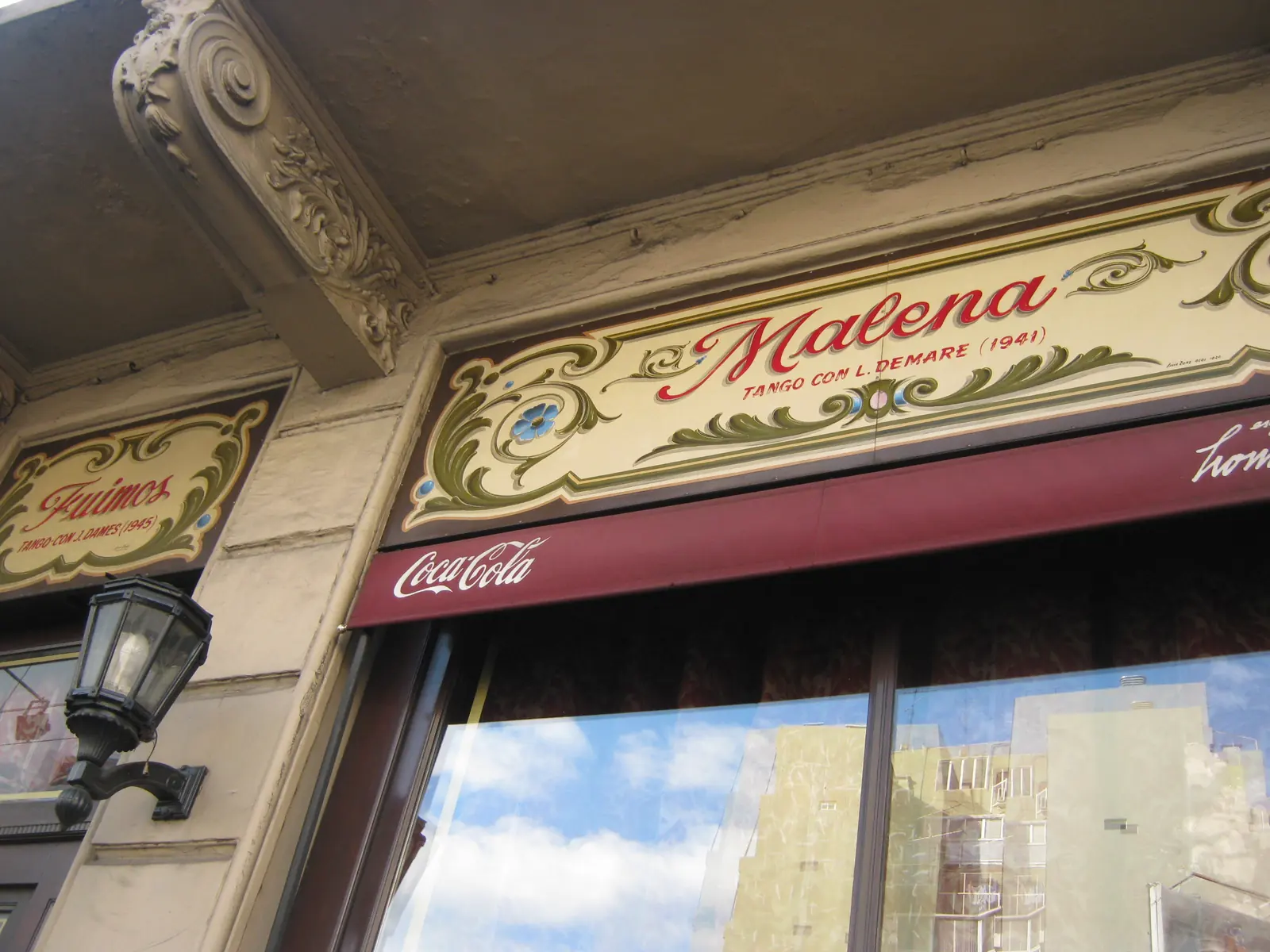
The venue says the bar on this corner was built in 1927 and became a symbol of the city’s urban culture in the 1940s. Buenos Aires city tourism says some locals recall a bar here as early as 1914. It names the bar El Aeroplano first, then Nippon from 1937 after Japanese partners bought it, then Canadian from 1948, and says the present name dates from 1981. The café closed on 6 March 1999, and reopened in 2001 after a restoration that kept its original façades. Several plaques decorate the façade, among them one from the Senate declaring the corner a National Historic Site, and painted lettering above the windows names Manzi tangos with their composers and years. Ten minutes outside in daylight is time well spent.
From a café table to the stage
Today the café is a tango dinner house. The venue describes a show built around the compositions of Manzi, with tributes to Carlos Gardel, set in what it calls the golden age of tango, with fifteen artists on stage. Wikipedia dates that golden age from about 1935 to 1952, so Sur belongs to its later years. Programmes change, so no piece is promised, but the evening is built on the songs that put this corner in the city’s memory. You are sitting on the corner those songs made famous.
Read next: Homero Manzi tango show: tickets
Who this isn’t for
Visit the corner for the history and you may be disappointed: it is a working restaurant, not a museum. A tango show in the evening is the main reason to go in. If you want the lyrics explained line by line, read a translation first, since Manzi wrote in Spanish. And if you prefer small rooms, bear in mind that the hall is large; the guide to the tickets says more about that. Nor is the show a lecture: it presents tango rather than Manzi’s biography, so read the corner’s story here beforehand if it matters to you.
Frequently asked questions
Who was Homero Manzi?
A tango lyricist and filmmaker, born on 1 November 1907 in Añatuya and died on 3 May 1951 in Buenos Aires.
Where did Manzi write Sur?
Buenos Aires city tourism says he wrote it in 1948 at one of the tables of the café on the corner of San Juan and Boedo.
When was the café built?
The venue says 1927. City tourism adds that some locals recall a bar on the corner as early as 1914.
Is the corner a historic site?
Yes. City tourism says a Senate plaque on the façade declares it a National Historic Site.
What does Sur mean?
Sur is Spanish for south. Wikipedia says the song is set among landmarks of the south side of Buenos Aires.
Can I see the corner without booking a show?
Yes. The plaques and signs are on the street outside; the show and dinner are inside.
Sources